Is Reshoring Injection Molding Right for Your OEM?
Metal may be the existing material for a component because it’s what has always been used, or because it was once perceived as the only viable option. But that doesn’t necessarily mean it’s still the best material or manufacturing process for the application.
This becomes especially worth evaluating when a metal component is produced at higher volumes, carries a high piece price, requires multiple manufacturing operations, or has long or unpredictable production lead times.
In the right application, converting from metal to injection-molded plastic can significantly change the economics of a program. Beyond reducing weight, a properly designed plastic component may eliminate machining and finishing operations, consolidate multiple components, reduce assembly, address corrosion or other performance issues, and provide a more efficient process for high-volume production.
In some applications, the resulting cost savings can be substantial.
But a successful metal-to-plastic conversion isn't as simple as recreating the same geometry in a different material.
Metal and plastic behave differently. The better question is:
Can the component be redesigned around an engineered plastic and the injection molding process while still meeting or improving its performance requirements?
That's where the evaluation should begin.
Step One: Understand What the Part Needs to Do
Before looking at materials or potential cost savings, start with the requirements that can't change.
Depending on the application, those may include:
- Impact and load requirements
- Stiffness and strength
- Vibration
- Chemical exposure
- UV and moisture exposure
- Operating temperatures
- Dimensional stability
- Electrical or thermal requirements
- Expected service life
- Potential failure modes
Plastic isn't the right answer for every metal component.
Some applications require temperatures, loads, stiffness, conductivity, wear resistance, or other characteristics that are better suited for metal. In other applications, an engineered or filled thermoplastic can meet the necessary requirements while creating opportunities that aren't available with the existing metal design.
The goal isn't to force a conversion. It's to determine which manufacturing approach makes the most sense for the application.
Step Two: Look at the Entire Cost of the Existing Metal Component
Piece price is an obvious place to start, but it doesn't always tell the entire story.
Consider everything required to turn the raw material into a finished component.
Does the part require:
- Machining?
- Stamping or forming?
- Welding?
- Tapping or threaded features?
- Fasteners?
- Coating or plating?
- Painting or finishing?
- Multiple components?
- Manual assembly?
- Multiple suppliers or manufacturing steps?
Those operations can add cost, labor, handling, inventory, and lead time.
Injection molding creates an opportunity to rethink those steps rather than simply replace the material.
Features that previously required separate operations may be molded directly into the component. Multiple metal pieces may be consolidated into a single molded part. Ribs, bosses, clips, mounting features, textures, lettering, and other geometry can potentially become part of the molded design.
At higher production volumes, eliminating even a small amount of cost from each component can have a significant impact over the life of the program.
For the right application, the savings can be dramatic. We've seen metal-to-plastic opportunities where the redesigned molded component reduced manufacturing cost by 90% or more.
That isn't a realistic expectation for every conversion, but it demonstrates why expensive, high-volume metal components are worth evaluating rather than assuming the existing process is the only option.
Step Three: Consider Production Volume and Lead Time
Injection molding requires an upfront tooling investment, which is why production volume matters.
For a low-volume component, building a production mold may not make financial sense. As annual volume and program life increase, however, the tooling investment can be spread across significantly more parts.
That can change the economics considerably.
High-volume metal components can also involve multiple manufacturing processes and suppliers before a finished part is ready. If machining, forming, welding, finishing, assembly, or outside processing are involved, production lead times can become another reason to evaluate the process.
Once tooling and the molding process are established, injection molding can repeatedly produce finished or near-finished components at scale with a highly repeatable process.
For an OEM purchasing tens or hundreds of thousands of the same metal component every year, it's worth asking whether the current manufacturing process still makes sense at that scale.
Step Four: Look for Opportunities to Improve the Part
Cost may start the conversation, but it doesn't have to be the only benefit.
Reduce Weight
Engineered plastics can provide substantial weight reduction compared with metal.
For one component, that may mean ounces or pounds. Across a larger assembly or high production volumes, those reductions can become significant and may also reduce shipping and handling costs.
Eliminate Corrosion
A metal component exposed to moisture, chemicals, salt, or other environmental conditions may require coatings, plating, paint, or other protection which all add cost.
Selecting an engineered thermoplastic around the actual operating environment may eliminate the corrosion concern along with some of the processes used to protect the metal.
Consolidate Parts
This can be one of the biggest opportunities.
An assembly consisting of several metal components, fasteners, welds, or brackets may potentially be redesigned as one molded component.
Part consolidation can reduce purchased components, inventory, assembly labor, and potential failure points while simplifying the overall manufacturing process.
Integrate Features
Injection molding allows engineers to create geometry that may be difficult or expensive to manufacture in metal.
Properly designed ribbing can add strength without simply making walls thicker. Bosses, clips, mounting points, locating features, text, and other functions may be incorporated directly into the molded component.
Improve Repeatability and Scalability
Once a mold and molding process are properly developed, injection molding is well suited to producing large quantities of consistent components.
That repeatability can become increasingly valuable as a program grows and production demand increases.
Step Five: Redesign the Part for Plastic
This is where many metal-to-plastic evaluations either succeed or fail.
Don't simply take the metal CAD model, select a plastic resin, and build a mold around it.
A part designed for machining, stamping, casting, or fabrication was designed around a completely different manufacturing process.
Injection molding introduces its own design considerations, including:
- Wall thickness
- Rib and gusset design
- Draft
- Material flow
- Shrink
- Warpage
- Bosses and attachment points
- Parting lines
- Ejection
- Gate location
- Tool construction
- Material orientation with filled resins
But redesigning the component also creates opportunity.
Instead of asking how to make the metal design out of plastic, ask what the component could look like if it had originally been designed for injection molding.
That shift in thinking can uncover improvements well beyond the original reason for considering the conversion.
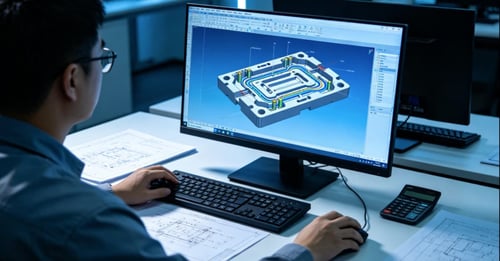
This is where an early design for manufacturability (DFM) review becomes valuable.
Aroplax works with OEM engineering teams before tooling to evaluate the application, material requirements, geometry, tooling strategy, production volume, and manufacturing economics together.
The objective isn't simply to mold the existing part. It's to determine whether the entire program can be better.
Related Content: Why Involving Your Injection Molding Partner Early Leads to Better Products
What Should Engineers Evaluate Before Making a Decision?
Before moving forward with a metal-to-plastic conversion, work through these questions:
- Performance: What absolutely can't change?
- Current cost: What does the finished metal component actually cost?
- Current process: How many manufacturing and secondary operations are required?
- Volume: How many components are produced annually, and what is the expected program life?
- Lead time: Is the existing process creating sourcing, inventory, or production challenges?
- Material: Which engineered resin properties match the application's requirements?
- Design: How could the component be redesigned specifically for injection molding?
- Part consolidation: Can multiple components or operations be eliminated?
- Tooling: What tooling strategy makes sense for the expected production volume?
- Validation: How will the redesigned component be tested and qualified?
- Total economics: What does the conversion look like after tooling, piece price, secondary operations, assembly, freight, inventory, and expected program life are considered?
You may come out of that evaluation with a strong case for conversion. You may also determine that metal is still the right material for the application.
Both are useful outcomes.
A metal-to-plastic conversion is an engineering and manufacturing exercise, not simply a material substitution.
When the application and production volume make sense, however, the opportunity can go well beyond reducing weight. A properly engineered conversion can reduce piece price, eliminate secondary operations, consolidate components, shorten production lead times, improve performance, and create a more scalable manufacturing process.
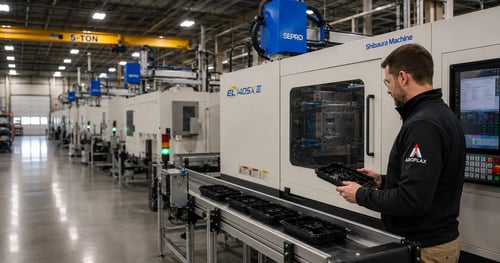
Aroplax works with OEM engineering teams during DFM to evaluate those opportunities before a mold is built. Our capabilities include engineering-grade and filled thermoplastics, insert molding, overmolding, advanced tooling, material selection support, automation, and high-volume injection molding.
Have a high-volume metal component that's expensive, difficult to source, or taking too long to produce? Let's take a look at the application and determine whether it could be a candidate for injection-molded plastic.
Aroplax is a Minnesota-based full-service custom injection molding manufacturer, supporting OEMs across a wide range of industries. Our capabilities include custom injection molding, advanced tool design and strategy, in depth design for manufacturability support (DFM), engineering, prototyping, and material selection expertise.