What Changes When Molding and Secondary Operations Happen in One Place?
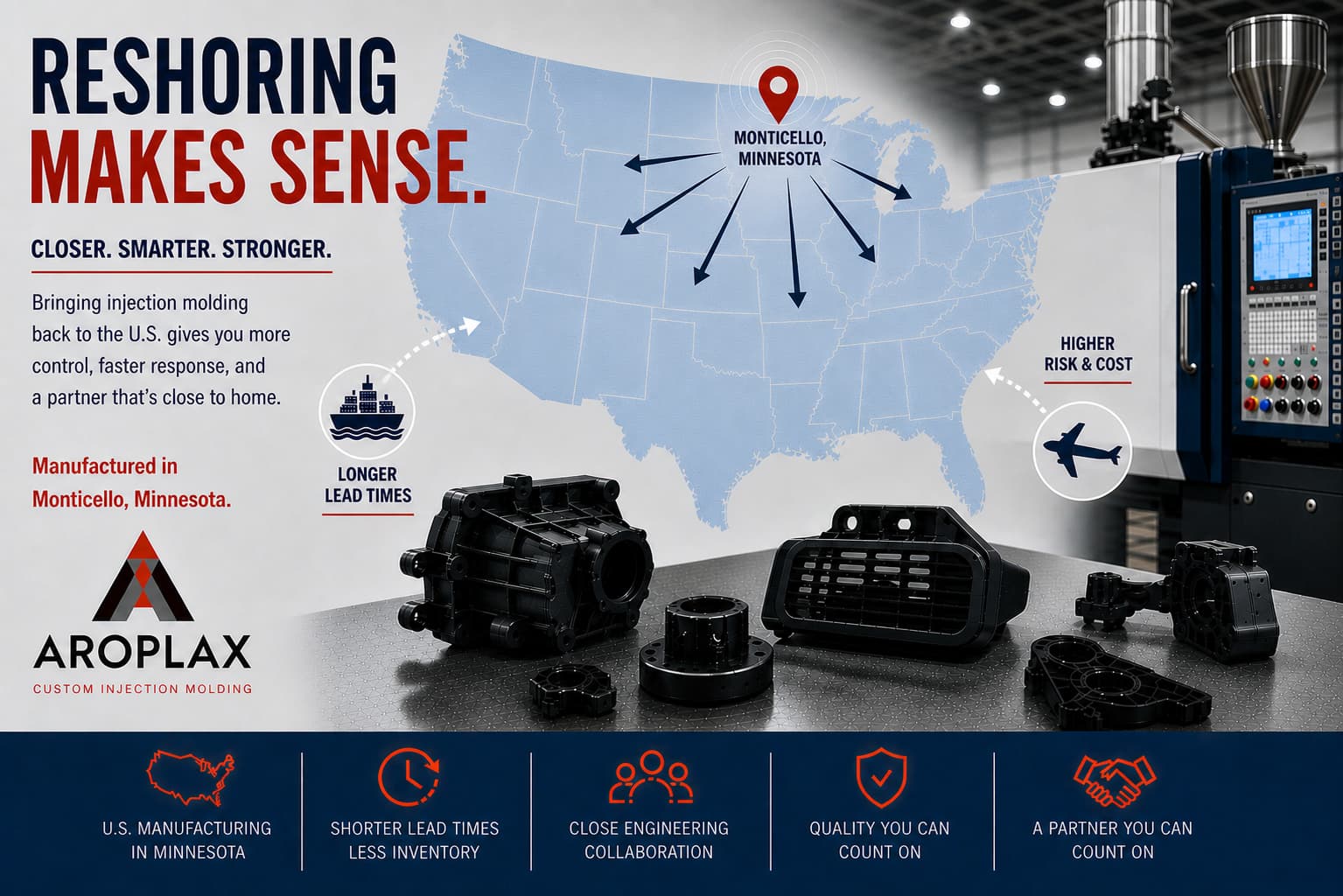
Reshoring injection molding can give OEMs more control over their supply chain, shorten the distance between engineering and production, and make it easier to respond when a program changes. But that doesn't mean domestic production is automatically the right choice for every part.
The decision depends on what your program requires. Cost matters, but so do lead times, inventory, quality requirements, communication, supply chain risk, compliance, and long-term support.
If you're evaluating whether to bring production back to the U.S., these are the factors worth looking at before making the move.
What Should You Evaluate Before Considering Reshoring?
1. Total Cost of Ownership
Piece price is one part of the sourcing decision, but it doesn't always tell the full story.
Freight, tariffs and duties, inventory, warehousing, secondary operations, travel, expedited shipping, and the internal resources required to manage a longer supply chain can all affect the true cost of a program.
Then there's the cost of managing it.
How much inventory do you need to hold between shipments? How far ahead do you need to forecast demand? How much time does your team spend coordinating logistics or resolving production issues? What happens when demand changes and you need parts sooner than expected?
For some programs, overseas production can still provide a cost advantage. For others, that advantage can become much smaller once the total landed and operational costs are considered.
Looking at the entire program gives you a much more useful comparison than piece price alone.
2. Lead Times and Inventory
Longer supply chains often require OEMs to forecast further ahead and carry more inventory between shipments.
That may work well for a mature program with stable, predictable demand. It can become more challenging when volumes fluctuate, production schedules change, or demand increases unexpectedly.
Domestic production shortens the physical distance between your manufacturing operation and your supplier, which can create opportunities for shorter replenishment cycles and lower inventory commitments.
That doesn't mean everything automatically becomes faster. Domestic and overseas molders may still be dependent on the same resin suppliers, purchased components, or specialty materials.
The difference is often in how quickly the overall program can respond.
When a production need changes, a question comes up, or additional parts are required, having manufacturing closer to your operation can make it easier to react without accounting for weeks of international transportation.
3. Quality, Process Control, and Compliance
Quality requirements vary significantly by part, application, and industry.
Depending on the program, an OEM may require inspection records, process data, material certifications, traceability, regulatory documentation, or direct access to quality reporting.
Domestic production can make it easier for OEMs to stay closer to that process. Plant visits, quality reviews, production discussions, and corrective actions don't require international travel or coordination across major time differences.
That proximity can become especially valuable when a problem occurs.
The question isn't whether an overseas supplier can produce quality parts. Many do.
The question is how much visibility, access, documentation, and responsiveness your particular program requires.
4. Communication and Engineering Support
Some injection molding programs require relatively little interaction once production is established. Others require ongoing collaboration.
Designs change. Materials are evaluated. Demand increases. Automation opportunities emerge. Quality issues need to be solved. Parts may need to be revised as the OEM's product evolves.
For those programs, access to the people supporting production can make a significant difference.
How easily can your engineering team communicate with the manufacturer? How quickly can everyone get together when a production issue occurs? Can your team visit the facility when needed? How involved is your manufacturing partner when something changes?
Time zones, travel, and communication structures can all affect those interactions.
For programs requiring close collaboration, domestic manufacturing can put engineering, quality, production, and the OEM much closer together.
5. Supply Chain Risk and Flexibility
Reshoring doesn't eliminate supply chain risk, but it can reduce exposure to some of the variables associated with a global supply chain.
International production can introduce longer transportation routes, port delays, geopolitical uncertainty, tariffs, changing freight costs, and longer recovery periods when something doesn't go according to plan.
The importance of those risks depends heavily on the program.
If a component is easily forecasted, non-critical, and supported by adequate inventory, those risks may be manageable.
If it's a high-volume component that can interrupt your production when supply is disrupted, the calculation may look very different.
Domestic manufacturing can reduce the distance between production and the OEM while giving purchasing and operations teams greater flexibility to react as demand or market conditions change.
6. Confidentiality and Intellectual Property
For some OEMs, where and how product information is shared is another important consideration.
Proprietary designs, new product development, customer requirements, intellectual property, or internal policies may require tighter controls over who has access to program information.
This doesn't automatically rule out overseas manufacturing. Appropriate confidentiality and IP protections can be established with suppliers anywhere in the world.
But when the sensitivity of a program increases, OEMs should consider whether the sourcing structure provides the level of control and visibility they require.
How Do Domestic and Overseas Injection Molding Compare?
Neither approach is universally better. The requirements of the individual program should drive the sourcing strategy.
| Consideration | Domestic Production May Fit When... | Overseas Production May Fit When... |
|---|---|---|
|
$ Total Cost |
Freight, tariffs, inventory, logistics, and program management significantly affect total cost. | Total landed cost remains advantageous and longer logistics cycles are manageable. |
|
◷ Lead Times & Inventory |
Shorter replenishment cycles, lower inventory commitments, and flexibility around changing demand are important. | Demand is stable and predictable enough to support longer planning and replenishment cycles. |
|
✓ Quality & Process Control |
Close process visibility, documentation, traceability, and easier access for reviews are valuable. | The supplier consistently meets the program’s quality and documentation requirements. |
|
☎ Communication & Engineering Support |
Frequent collaboration, DFM support, troubleshooting, or engineering changes are expected. | The product and process are mature and require relatively little ongoing support. |
|
◎ Supply Chain Risk |
Reducing exposure to long transit routes, tariffs, geopolitical changes, or global disruptions is a priority. | Inventory, diversified supply, and predictable logistics adequately manage those risks. |
|
🔒 Confidentiality & IP |
Proprietary designs, customer requirements, or internal policies benefit from tighter control over program information. | Established confidentiality and IP protections satisfy the OEM’s requirements. |
When Does Reshoring Make the Most Sense?
The strongest reshoring opportunities aren't necessarily the parts with the highest overseas piece price.
They're often programs where several factors begin stacking up.
Maybe you're carrying months of inventory. Freight and tariffs continue adding cost. Your team needs more flexibility when demand changes. Engineering needs better access to manufacturing. Quality issues take too long to resolve. Or a critical component simply carries more supply chain exposure than you're comfortable with.
When several of those factors exist within the same program, the value of domestic manufacturing can look very different than it does on a piece-price comparison.
That's why a sourcing conversation with Aroplax starts with the program itself: what you're making, the volumes you need, how production needs to run, and where the biggest costs, risks, and opportunities exist.
We manufacture in Minnesota, allowing our team to work closely with customers throughout DFM, production, quality, automation, assembly, and ongoing program support.
Explore Reshoring Options for Your Injection Molding Program
Aroplax is a Minnesota-based custom injection molding manufacturer supporting OEMs across a wide range of industries.
Our capabilities include custom injection molding, DFM and engineering support, material selection, automation, assembly, secondary operations, and ongoing production support.
If you're evaluating whether to reshore an existing injection molding program or source a new program domestically, talk with our team about what you're currently doing and what you need from your manufacturing partner.
The goal isn't simply to bring production back to the U.S. It's to determine whether bringing it closer can make the overall program better.
Aroplax is a Minnesota-based full-service custom injection molding manufacturer, supporting OEMs across a wide range of industries. Our capabilities include custom injection molding, advanced tool design and strategy, in depth design for manufacturability support (DFM), engineering, prototyping, and material selection expertise.