What Changes When Molding and Secondary Operations Happen in One Place?
When manufacturing hundreds of thousands or millions of injection-molded components annually, even small inefficiencies can significantly impact overall production costs.
Manual part handling, unnecessary secondary operations, inefficient cycle times, and production interruptions all contribute to the total cost of manufacturing a component. Over the life of a high-volume program, these costs add up.
That's where automation creates real value.
At Aroplax, automation is an integral part of our manufacturing operations. With robotic systems on every injection molding press, we focus on developing efficient, repeatable production processes that reduce unnecessary manual intervention, improve equipment utilization, and support consistent quality.
However, automated manufacturing doesn't necessarily mean completely unattended production. The objective is to use automation where it provides measurable value, allowing equipment and employees to operate as efficiently as possible.
For OEMs, the result can be more competitive production costs, reliable output, and manufacturing processes capable of supporting long-term growth.
1. Reducing Labor Requirements Through Robotic Automation
One of the most significant advantages of automated injection molding is the ability to reduce the amount of manual labor required during production.
In a labor-intensive molding process, an operator may need to remain at a press to remove finished components, separate parts, perform repetitive handling tasks, or prepare products for subsequent operations.
While these tasks may seem minor individually, the associated labor costs become substantial when repeated thousands or millions of times.
Robotic automation can eliminate or reduce many of these repetitive activities.
For example, automated part removal systems can consistently extract molded components from the press and place them into designated containers or downstream handling equipment without requiring an operator to perform each cycle manually.
This creates benefits beyond simply removing a manual task.
When a molding process requires less operator involvement, employees can oversee multiple presses rather than being dedicated to a single machine throughout an entire shift.
This improves labor utilization, reduces the labor cost associated with each manufactured component, and allows employees to focus on higher-value activities such as quality verification, material management, and production support.
At Aroplax, our approach isn't to eliminate operators from manufacturing. It's to use automation strategically, allowing our people and equipment to work more efficiently together.
2. Supporting Lights-Out and Extended Automated Production
Another advantage of well-designed automated injection molding processes is the ability to support extended production with minimal manual intervention.
Often referred to as lights-out manufacturing, this approach uses automation, reliable tooling, and stable processing conditions to allow equipment to operate for extended periods without requiring continuous operator interaction.
However, not every injection molding application is suitable for fully unattended production.
Part complexity, material characteristics, quality requirements, downstream operations, and equipment capabilities all influence the level of automation that can be implemented.
Successful lights-out or extended automated production requires more than simply installing a robot on a press.
It starts with developing a reliable manufacturing process that considers:
- Consistent material delivery and processing conditions.
- Tooling designed for dependable, repeatable operation.
- Automated part removal and handling.
- Appropriate equipment monitoring and process controls.
- Quality requirements and methods for identifying production issues.
- Efficient material handling and finished-part collection.
When these elements work together, manufacturers can reduce routine operator intervention and improve the consistency of extended production runs.
At Aroplax, we evaluate automation opportunities based on the actual requirements of each program, recognizing that some applications can support greater levels of automation than others.
The goal is not to automate every activity simply because it's possible. It's to develop the most efficient, reliable manufacturing process for the product.
3. Improving Production Efficiency Through Tooling and Cycle Time Optimization
Robotic automation is only one part of an efficient high-volume injection molding operation.
The design of the part, mold construction, cavitation, material selection, and molding cycle all influence how efficiently a component can be manufactured.
These factors are especially important when production volumes reach hundreds of thousands or millions of parts annually.
Consider a component with an unnecessarily long molding cycle. Even a small improvement in cycle time can translate into substantial additional production capacity over the course of a year.
Similarly, selecting the appropriate number of mold cavities can significantly influence production output and overall manufacturing cost.
A higher-cavitation mold produces more components per cycle, potentially increasing production capacity and reducing the manufacturing cost per part.
However, higher cavitation isn't automatically the best solution.
Tooling complexity, required press size, projected annual volumes, mold maintenance, production reliability, and upfront investment must all be considered.
At Aroplax, we evaluate these factors during tooling development and design for manufacturability (DFM) reviews to help determine the most appropriate manufacturing approach.
Sometimes the greatest opportunity isn't adding automation at all. It may be modifying a part design, improving tooling efficiency, or eliminating an unnecessary manufacturing step.
The objective is to optimize the entire process, not just one piece of equipment.
4. Reducing Secondary Operations and Manual Handling
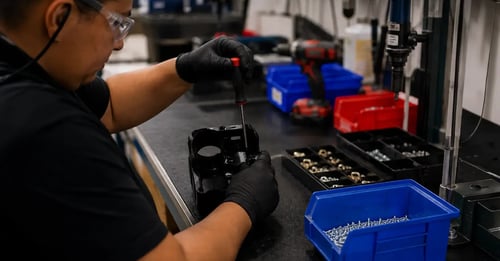
The cost of manufacturing a component doesn't always end when the molding cycle is complete. Depending on the application, molded components may require additional handling, assembly, labeling, packaging, or other secondary operations before they're ready for shipment.
Each additional step introduces potential labor, equipment, handling, and quality-related costs. At high production volumes, these activities can represent a meaningful portion of the total cost of a finished component. Automation creates opportunities to simplify or integrate these processes.
For example, robotic systems can transfer molded components directly into downstream handling equipment, reducing the need for employees to manually collect, move, and reposition parts.
In certain applications, assembly or other value-added operations can also be incorporated into an automated manufacturing process.
Design improvements may eliminate some secondary operations entirely.
A component that originally requires multiple individual parts and a separate assembly process may be redesigned to consolidate features or simplify assembly requirements.
These opportunities are often identified through early collaboration between the OEM and manufacturing team.
By evaluating the complete production process, from molding through finished-part packaging, manufacturers can identify opportunities to reduce handling, improve efficiency, and lower overall manufacturing costs.
At Aroplax, our injection molding, tooling, and secondary operation capabilities allow us to evaluate these opportunities as part of the overall manufacturing strategy.
5. Improving Process Consistency and Product Quality
High-volume production requires more than simply producing parts quickly.
Manufacturers must consistently meet dimensional, cosmetic, functional, and other customer-specific requirements throughout production. Automation can support this consistency by reducing variation associated with repetitive manual activities.
For example, robotic part removal provides a controlled, repeatable method for handling components after molding, potentially reducing handling damage and inconsistencies.
Stable molding processes, reliable tooling, and controlled operating parameters also contribute to repeatable production. However, automation does not replace quality assurance, although some quality processes can be built in through automation.
Even highly automated manufacturing processes require appropriate inspections, equipment maintenance, process monitoring, and ongoing verification that products meet customer specifications.
At Aroplax, quality requirements are established around the needs of each manufacturing program, with inspection procedures and process controls supporting consistent production.
The combination of automation, experienced employees, and established quality systems helps deliver the repeatability required for long-term, high-volume manufacturing.
6. Scaling Automated Manufacturing With Customer Demand
As an OEM's production requirements grow, the most efficient manufacturing approach may also change.
A program initially producing moderate annual volumes may eventually require expanded production capacity, additional tooling, increased automation, or dedicated manufacturing equipment. Planning for these possibilities early helps avoid unnecessary limitations as demand increases.
At Aroplax, we work with customers to understand both immediate production requirements and anticipated future growth. This allows us to evaluate tooling, equipment, and automation strategies that support the program's long-term needs.
In some cases, existing manufacturing equipment and automated processes can efficiently accommodate increased demand. In others, additional tooling, expanded automation, or dedicated injection molding equipment may provide greater value. It's one of several strategies available when demand, capacity requirements, and long-term program economics support the investment.
7. Identifying Automation Opportunities Before Production Begins
Some of the most valuable manufacturing improvements are identified before the first production mold is built.
Decisions made during part design and tooling development influence how efficiently a component can be manufactured throughout its production life.
For example, part geometry can affect mold complexity, cycle time, automated handling, and assembly requirements.
Features that simplify robotic removal or eliminate an additional manufacturing step can create meaningful savings over the life of a high-volume program.
Similarly, selecting the appropriate tooling configuration and considering automation requirements early can reduce the need for expensive modifications later.
This is why Aroplax emphasizes early engineering involvement and design for manufacturability.
Our team works with OEMs to evaluate part designs, tooling strategies, material considerations, production volumes, and opportunities for automation. By understanding the complete manufacturing process before production begins, we can identify improvements that support both immediate production requirements and long-term manufacturing efficiency.
Ultimately, the objective is to develop a process that delivers the required quality and performance at the lowest practical total manufacturing cost.
Why Automated Injection Molding Matters for High-Volume OEMs
For OEMs producing high volumes of plastic components, the benefits of automation extend well beyond reducing manual tasks.
When implemented strategically, automation supports more efficient labor utilization, greater equipment productivity, repeatable production, reduced handling, and improved overall manufacturing economics.
The most effective approach considers automation alongside part design, tooling, process development, and secondary operations rather than treating each as an independent activity.
At Aroplax, robotic automation is already integrated into our injection molding operations. Combined with our in-house automation building capabilities, engineering support, and value-added secondary operations, this allows us to develop scalable manufacturing solutions around the specific needs of our customers.
We recognize that not every application requires the same level of automation, and not every high-volume program needs dedicated equipment. What matters is developing the right manufacturing process for the part, the volume, and the customer's long-term objectives.
Do you have a High-Volume Injection Molding Program?
Whether you're developing a new product, evaluating an existing production program, or looking for opportunities to reduce long-term manufacturing costs, Aroplax can help.
Our team works with OEMs to identify opportunities through early DFM involvement, tooling optimization, automated injection molding, and integrated secondary operations. From initial development through high-volume production, our focus is on delivering efficient, reliable manufacturing solutions that support your business as it grows.
Contact Aroplax to discuss your next injection molding program.
Aroplax is a Minnesota-based full-service custom injection molding manufacturer, supporting OEMs across a wide range of industries. Our capabilities include custom injection molding, advanced tool design and strategy, in depth design for manufacturability support (DFM), engineering, prototyping, and material selection expertise.